Data provisioning
A generic database connector can be used to enable the data provisioning to SQL (Microsoft SQL Server and Oracle-based systems are supported).
Review the following practical example to learn how to use this connectivity.
Configuring data provisioning using the generic database connector (practical example)
Goal: Update the email of an identity in a database table named Identity. The unique key used to locate the record is UID.
Prerequisites: Ensure that the connector is configured correctly. See Generic SQL - SQL generic database.
- Define the data model.
<connectorDataModel xmlns="http://schemas.omada.net/ops/2015/ConnectorDataModelML" xmlns:xsi="http://www.w3.org/2001/XMLSchema-instance">
  <properties>
    <property name="UID" dataType="stringType"/>
    <property name="Email" dataType="stringType"/>
  </properties>
  <objects>
    <object name="Identity">
      <objectDetails>
        <objectDetail name="Schema" value="dbo" />
      </objectDetails>
      <objectProperties>
        <objectProperty isKey="true">UID</objectProperty>
        <objectProperty>Email</objectProperty>
      </objectProperties>
    </object>
  </objects>
</connectorDataModel>
UIDis marked as the key (isKey="true") that is used in the WHERE clause during updates and deletes.Emailis the attribute we want to update in the database.- The object name (
Identity) must match the name of the table in the target database. <objectDetail name="Schema" value="dbo" />defines the schema used in the database query, and must match the actual schema where the table resides.
You can use the following object details:
- Schema - the database schema where the related objects (tables or procedures) reside.
- IsStoredProcedure - indicates whether operations use stored procedures instead of inline SQL.
- ProcedureName - the base name of the stored procedure associated with the object.
- CreateProcedureName - the stored procedure's name used to create a new record.
- UpdateProcedureName - the stored procedure's name used to update an existing record.
- DeleteProcedureName - the stored procedure's name used to delete a record.
- ProcedureParameters - a comma- or semicolon-separated set of parameters used by the main stored procedure.
- CreateProcedureParameters - a comma- or semicolon-separated set of
parametersrequiredby the create stored procedure. - UpdateProcedureParameters - a comma- or semicolon-separated set of
parametersrequiredby the update stored procedure. - DeleteProcedureParameters - a comma- or semicolon-separated set of
parametersrequiredby the delete stored procedure. - CreateSqlTemplate - an SQL template used to generate INSERT statements (when stored procedures are not used).
- UpdateSqlTemplate - an SQL template used to generate UPDATE statements.
- DeleteSqlTemplate - an SQL template used to generate DELETE statements.
- Configure the task mapping to map the identity attributes to the database fields:
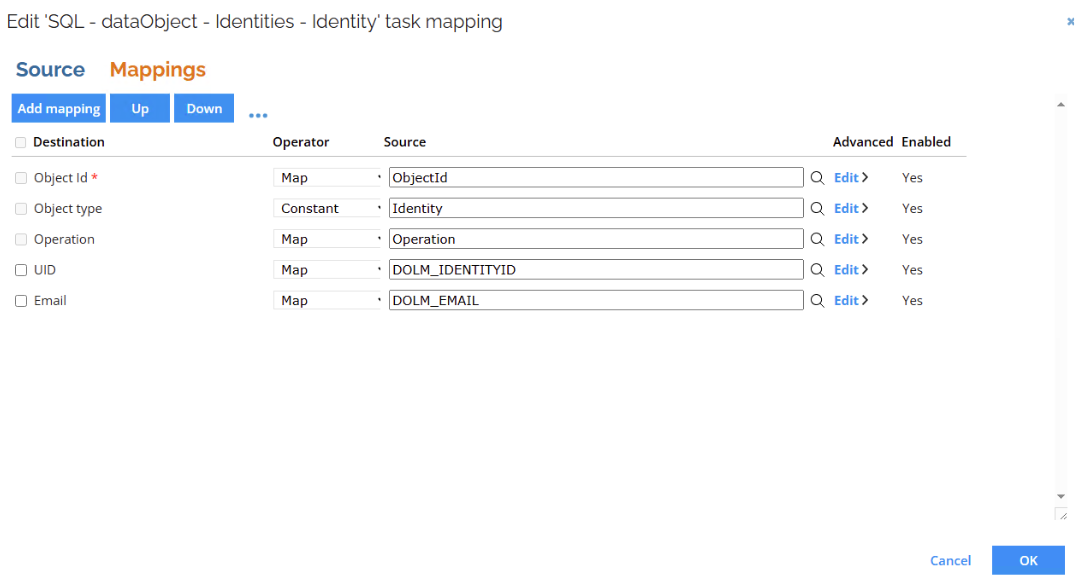
UIDis mapped toDOLM_IDENTITYID.Emailis mapped toDOLM_EMAIL.- Standard fields such as
Object Id,Object type, andOperationare required for the task to run correctly.
Expected result:
Example identity: Anna Becker
- UID: ABAA
- Current email:
ABAA@megamart.com
After changing the identity's email to annabecker@megamart.com, the provisioning is triggered and the connector executes the following statement:
UPDATE dbo.Identity
SET Email = 'ANNABECKER@MEGAMART.COM'
WHERE UID = 'ABAA';
The change is reflected directly in the database:
