Policy & Risk Check
The Policy & Risk checks help you identify rule violations before submitting an Access request.
Overview
Organizations can enable the Policy check simulation feature to prevent users from requesting access to resources that they should not have access to by checking for violations and/or risks when access is requested. This provides transparency into the policies that the organization has implemented and ensures a higher level of compliance.
Similarly, managers can use the Policy & Risk check feature to look for violations and risks before they approve the Access request. In this way, both parties review the Access request before the resources are approved and granted to the users. There are three policies or risk checks available:
-
SoD policy check checks for violations against constraint policies defined in Omada Identity. This check evaluates Segregation of Duties conflicts via a RoPE calculation.
tipFor more information, refer to the Segregation of Duties section.
-
Peer Access Analysis compares the identity's peer group through its context assignments and calculates a percentage of how closely the requested assignment matches the peer group. For example, a 100% match indicates that all of the person's peers are already assigned to the resource.
-
External Risk analysis is performed in SAP GRC Access Control (SAP GRC). Organizations can define risks and Segregation of Duties rules in SAP GRC for SAP roles that are more granular than those normally handled in Omada Identity.
Policy & Risk check configuration options
This section provides information about the configuration options of the selected Policy & Risk check and explains how each option affects the behavior of the selected Policy & Risk check during Access request and Access approval processes. Some of the options described on this page are configurable and can be enabled or disabled. Other options are informational only and reflect capabilities of the selected Policy & Risk check that cannot be changed.
You can access these options from Setup > Policy & Risk check, where you can view and configure the available Policy & Risk checks, including Segregation of Duties, Peer Access Analysis, and Risk analysis in SAP GRC. Once there, you will be able to see these options:

Below is a description of each configuration:
-
Inactive:
When you enable Inactive, the selected Policy & Risk check is disabled. If a Policy & Risk check is inactive, it is not executed during Access request or Access approval processes, regardless of other configuration options. The Policy & Risk check remains visible in the configuration view, but it does not produce any results or evaluations.
You can use this option to temporarily disable a Policy & Risk check without deleting its configuration.
-
Optional in access request:
When you enable Optional in the Access request, the Policy & Risk check becomes optional during the Access request process, and you can manually trigger the Policy & Risk check by clicking the arrow on the Next button.

When this option is unchecked, the Policy & Risk check runs automatically.

-
Hide in access request approval survey:
When you enable Hide in access request approval survey, the Policy & Risk check is not shown during the Access approval process. If this option is enabled, the Policy & Risk check results are hidden from the Approval survey. Functionally, the Policy & Risk check is treated as disabled during Access approval, even if it was executed during the Access request.
infoThis option overrides whether the Policy & Risk check is optional or mandatory during Access approval.
-
Mode:
This setting controls how the Policy & Risk check is executed. For Optional in access request and Hide in access request approval survey to work as expected, Mode must be set to Simulation or Both.
These modes define when and how the Policy & Risk check is executed within the workflow:
-
Simulation: The check is executed only during the Access request phase as a simulation. It provides early visibility of potential violations but does not trigger enforcement actions. This mode is required if you want to use the check as optional in the request flow.
-
Calculation: The check is executed in the Approval survey and is used for evaluation during Access approval. This mode is required if you want violations to be visible to approvers.
-
Both: Combines both behaviors: Simulation in the Access request and Calculation in the Approval survey.
-
The Optional in access request setting only works with Simulation or Both. The visibility of results in the Approval survey depends on using Calculation (or Both) and not enabling Hide in access request approval survey.
-
Allow mode change:
This field is informative and indicates whether the selected Policy & Risk check supports switching between Calculation, Simulation, or Both modes.
-
RoPE extension:
This field is only informative and indicates whether the selected Policy & Risk check uses a Role and Policy Engine (RoPE) extension.
-
Used for all resources:
When you enable it, the selected Policy & Risk check is applied to all resource assignments.
For example, if you enable this option for Segregation of Duties, SoD checks are applied to all resource assignments in the system.
infoIf this option is not enabled, you can select different Policy & Risk checks per resource assignment or per resource folder.
-
Configuration data:
It contains additional configuration information used by the selected Policy & Risk check.
This data is used internally by the Policy & Risk check during execution to support specific behavior or integrations. The content and structure of the configuration data depend on the type of Policy & Risk check, for example, Segregation of Duties, Peer Access Analysis, or Risk analysis in SAP GRC.
You typically configure this field only when required by the selected Policy & Risk check. If no additional configuration is needed, the field can remain empty.
Read below to learn about the three policies or risk checks available:
SoD Policy check
When a user requests access to resources, the request may violate one or more policies configured in Omada Identity. The Role and Policy Engine (RoPE) performs the final policy evaluation after the required approvals are completed (for example, by managers or system owners).
If violations are detected during the final RoPE calculation, a violation evaluation task is triggered and sent to the relevant manager. In such cases, the manager must approve the violation and provide a compensating control (a justification for the violation of the established policy).
In a standard installation, a security officer must also approve the manager’s decision before access is granted.
Access request workflow
Omada Identity provides up to three Policy & Risk checks: Segregation of Duties (SoD), Peer Access Analysis, and Risk analysis in SAP GRC. Each check is enabled independently and can be configured as Optional or Mandatory on its own (Setup > Policy & Risk check).
During the access request flow, these checks run as a simulation — a preview of violations and risks before the user submits. An enabled check is any check that is not set to Inactive. The behavior depends on the combined configuration of the enabled checks:
- If at least one enabled check is Mandatory (Optional in access request unchecked), all enabled checks run automatically as the user progresses through the workflow (on Next in step 2 / on Submit). Results are shown in step 4.
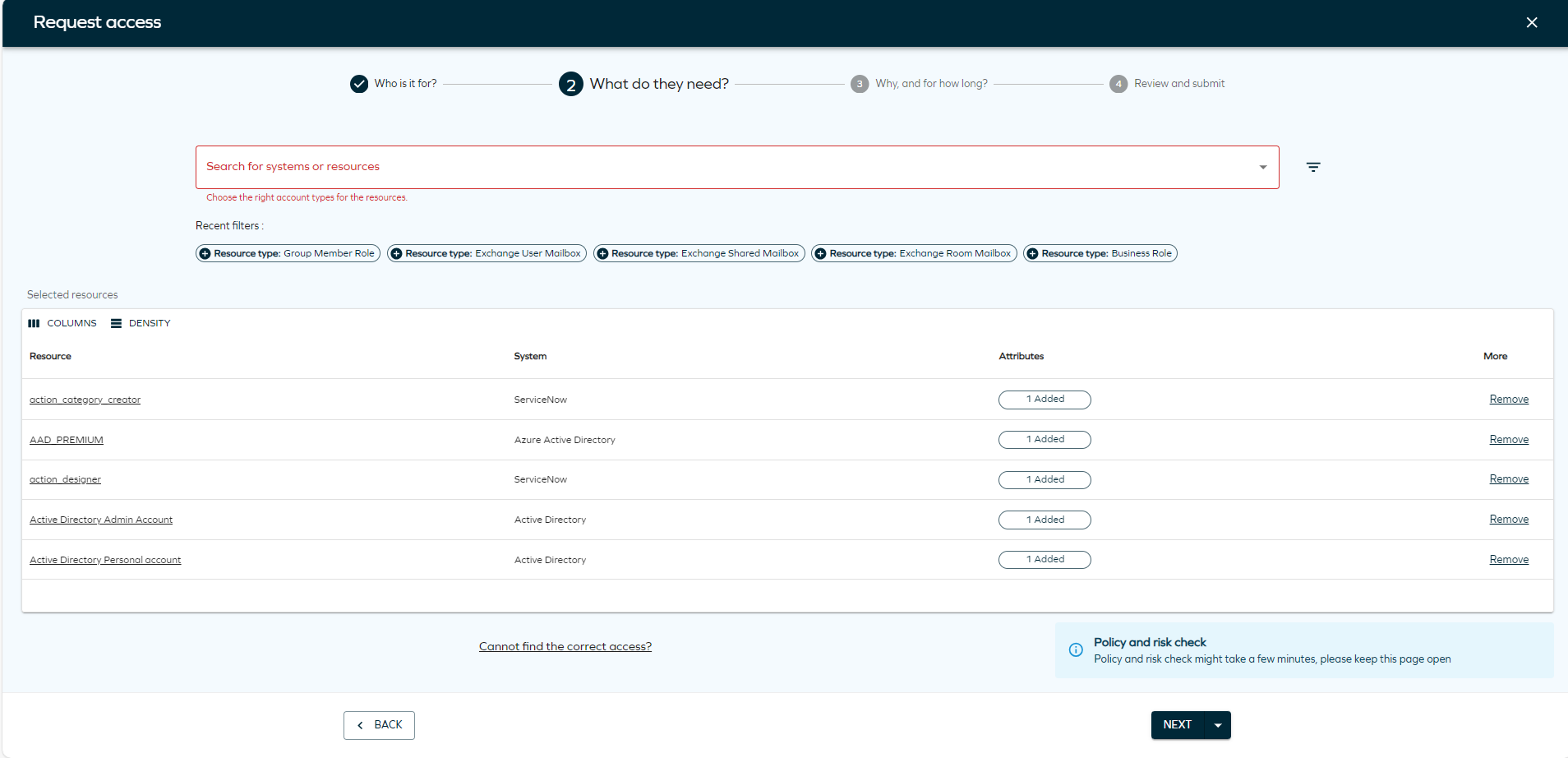
- If all enabled checks are Optional, no check runs automatically. The user triggers them manually using the dropdown arrow on the Next button, or Run Policy & risk checks before submitting.

This simulation is a preview only and does not trigger the violation evaluation workflow. For the binding evaluation, see Policy check execution logic.
Access approval workflow
The same three Policy & Risk checks used in the access request, Segregation of Duties (SoD), Peer Access Analysis, and Risk analysis in SAP GRC can also run during the access approval process, so the approver (typically the manager, resource owner, or system owner) can review violations and risks before approving.
Policy & risk checks start automatically when the approver opens the Approval page. The approver can also re-run them manually using the Run risk check button (for example, after changing the request).
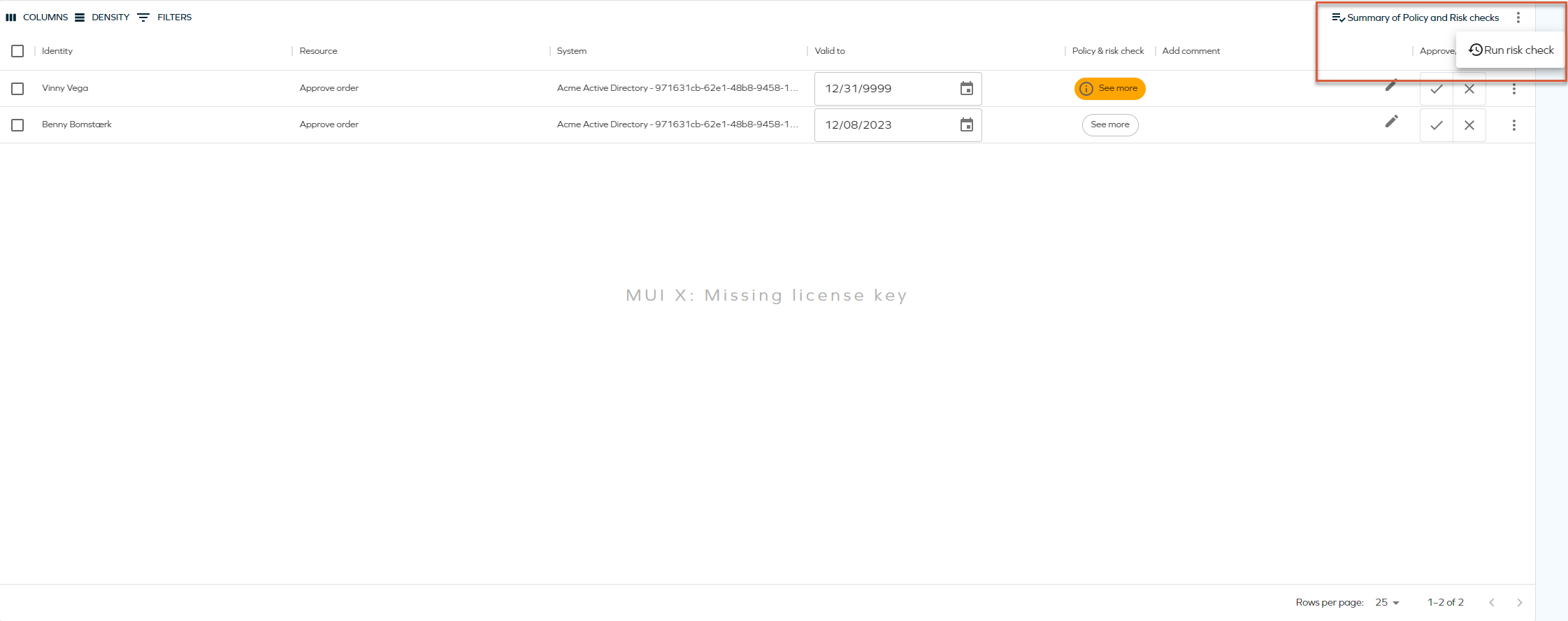
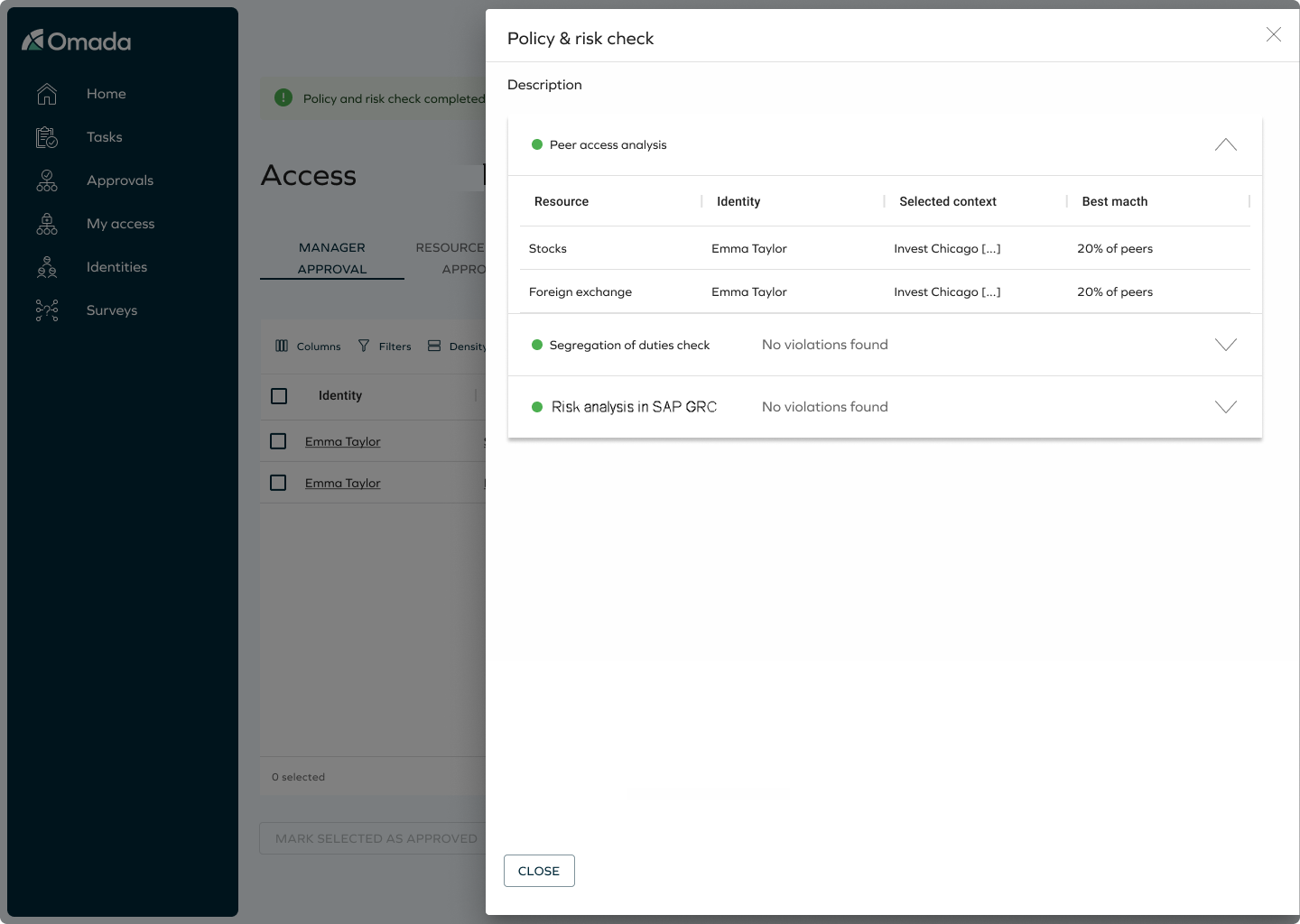
Unless a check is set to Hide in the approval survey (which hides it during approval and overrides its Optional/Mandatory setting), its results appear in the Policy & Risk Check column. Click See More to open the summary, with Peer Access Analysis, Segregation of Duties, and SAP GRC shown in accordion sections. If there are no violations, a confirmation message is shown.
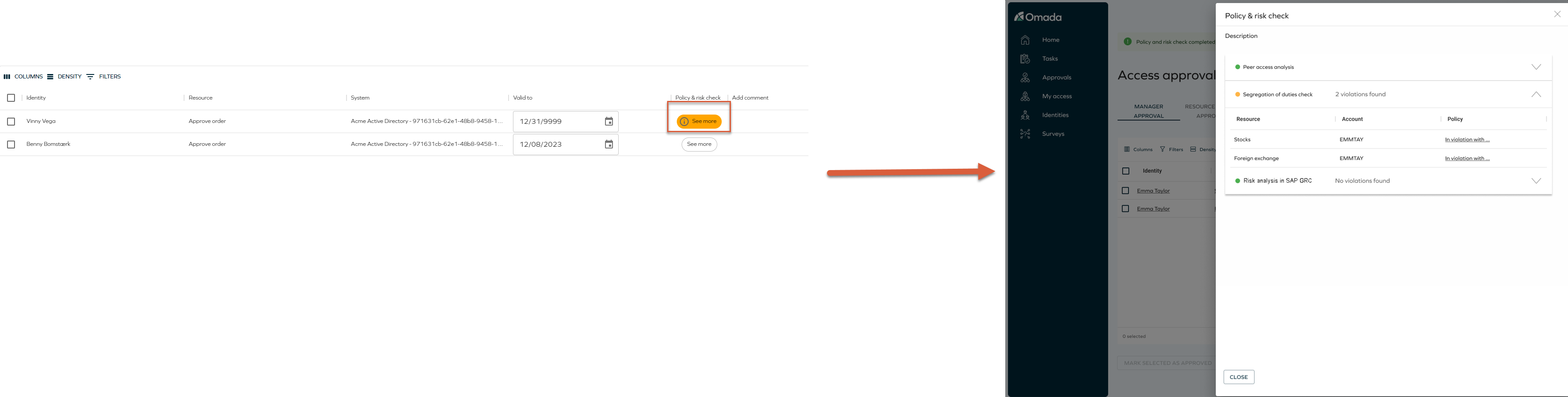
If violations are detected, a warning is shown; click See More to inspect the violations summary.
The approver then approves or rejects each request. You can approve every assignment with no risks or violations at once using Approve all without a warning. A rejected request is considered complete and cannot be disputed, but the requester can submit it again with a comment.
As in the access request, this is a simulation. It does not trigger the violation evaluation workflow. The binding evaluation runs only after all approvals are completed; see Policy check execution logic.
Policy check execution logic
Final RoPE policy check
Independent of the simulation, the Role and Policy Engine (RoPE) performs the binding Policy check, the evaluation of constraint (Segregation of Duties) policies, after all required approvals are completed. This is the real evaluation, not the preview, and it always runs regardless of the Optional/Mandatory simulation settings.
If violations are detected:
- An Evaluate violation task is triggered.
- The manager must approve the violation and provide a compensating control.
- In standard installations, a security officer must also approve the manager's decision before access is granted.
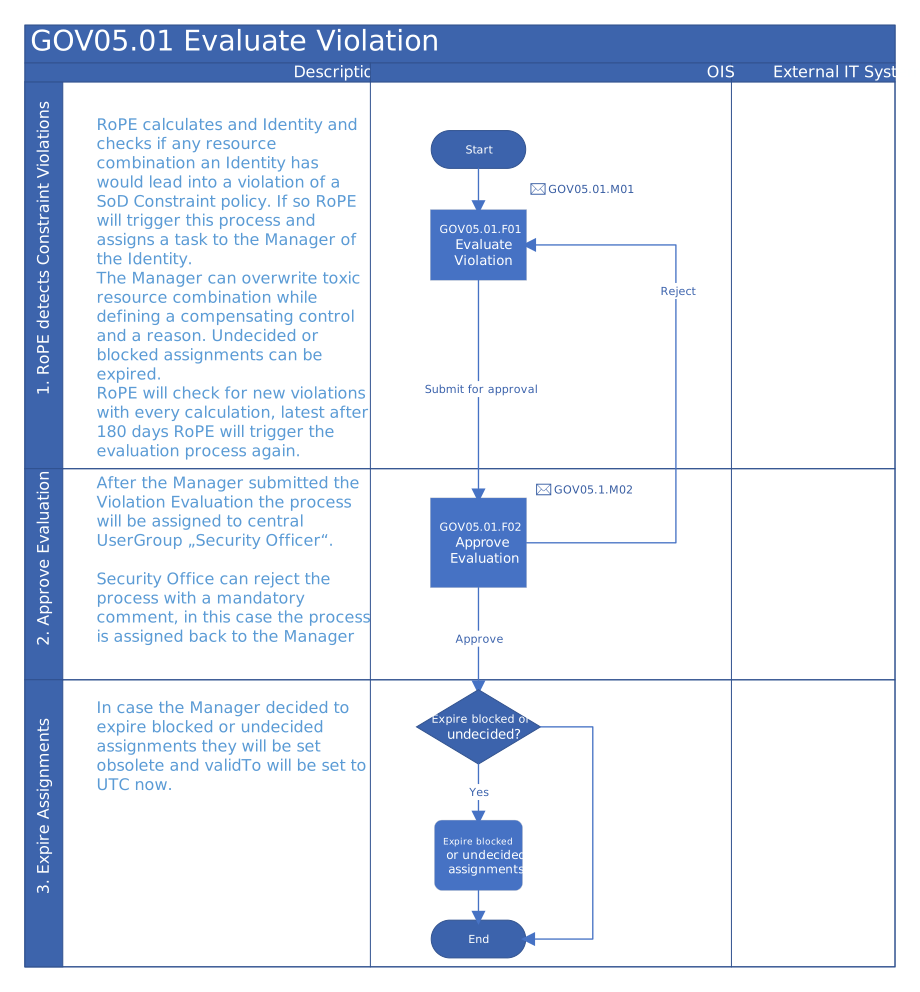
Peer Access Analysis and Risk analysis in SAP GRC provide decision support during the simulation; they do not trigger the Evaluate violation task. This task results specifically from SoD/constraint violations detected by RoPE.
Peer Access Analysis
The Peer Access Analysis provides intelligent decision support for requesters and approvers to confirm that the resources requested and approved match the user's peer group. The information is presented visually to provide immediate feedback, while still allowing drilldown into the data that forms the basis for the decision. Your organization can configure the Peer Access Analysis.
When requesting access to a given resource, a risk analysis of the assignment is performed based on the business context. When the context is selected during the Access request, the system analyzes the assignments of the identity's peers within the same context and shows the results in the Selected Context section of the window.
If the assignment matches the access that the identity's peers have, no warning is issued. If a mismatch is found, a warning is displayed. Depending on the percentage of peers with access to the same resource within the same context, a low, medium, or high risk is assigned to the request. The thresholds for medium and high risk are configurable. No warning is equivalent to low risk.
Peer Access Analysis requires a selected context to provide meaningful results. Without this context, while the analysis can be enabled, it will yield empty results. Therefore, we strongly recommend using peer access analysis in cases where context is necessary.
The Employment personal context is the only personal context used in the Peer Access Analysis process. The associated contexts are not considered for employment contexts. When the Peer Access Analysis is performed for employment, the parent org. unit is shown as the result.
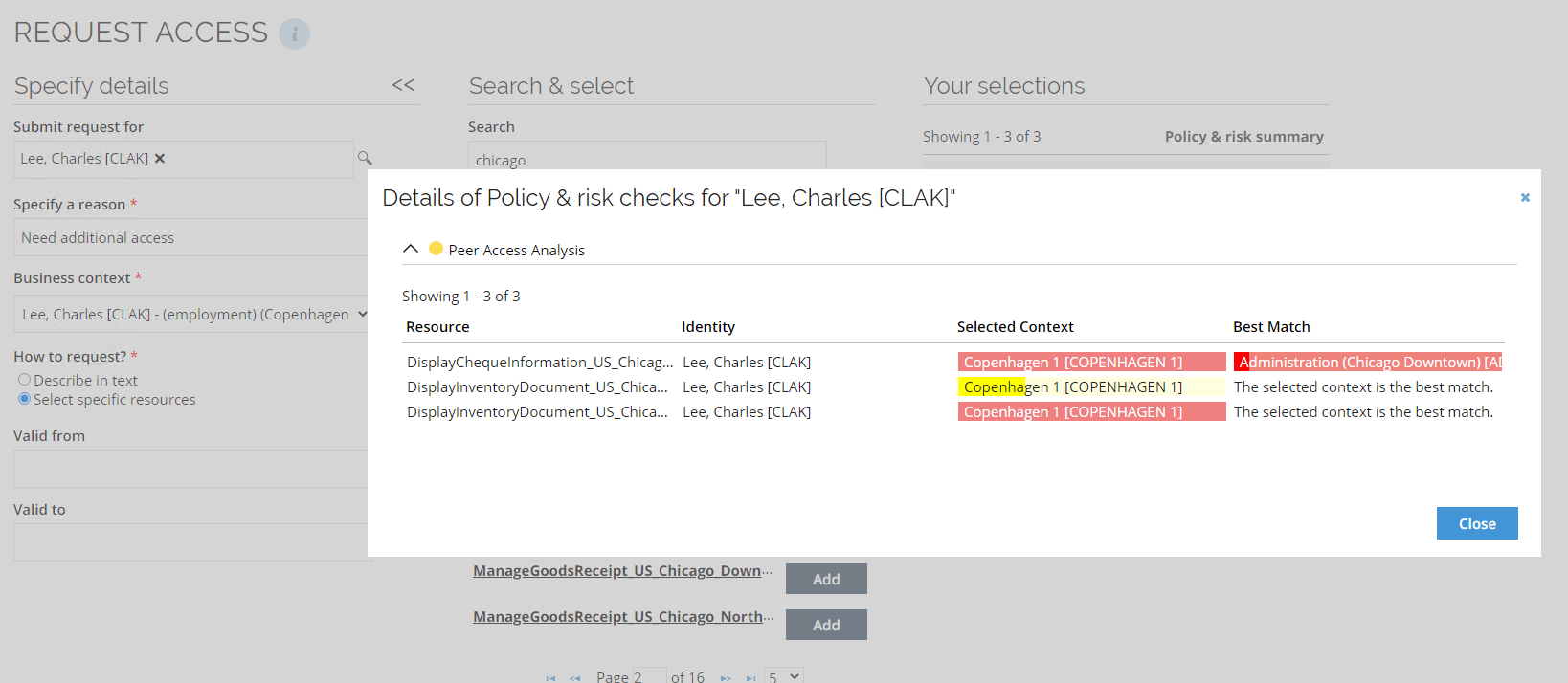
Peer access analysis in Access approval
The Peer Access Analysis is performed again within the Access approval workflow so that the approver can see it in the Approval survey when deciding whether to approve or reject the Access request.
Risk Analysis in SAP GRC
Risk analysis in SAP GRC checks assignments for risks and SoD violations in SAP GRC using the Risk Analysis Web Service. The result is returned to the user in both the Access request and Access approval processes.
This check is performed for the entire Access request basket in one simulation and is triggered when the user clicks Run Policy & Risk checks in the bottom toolbar.
The result of the check is shown via an icon in the processes to visualize and provide immediate guidance to the user. A summary of the GRC check is shown once the Policy & Risk checks have returned a result.
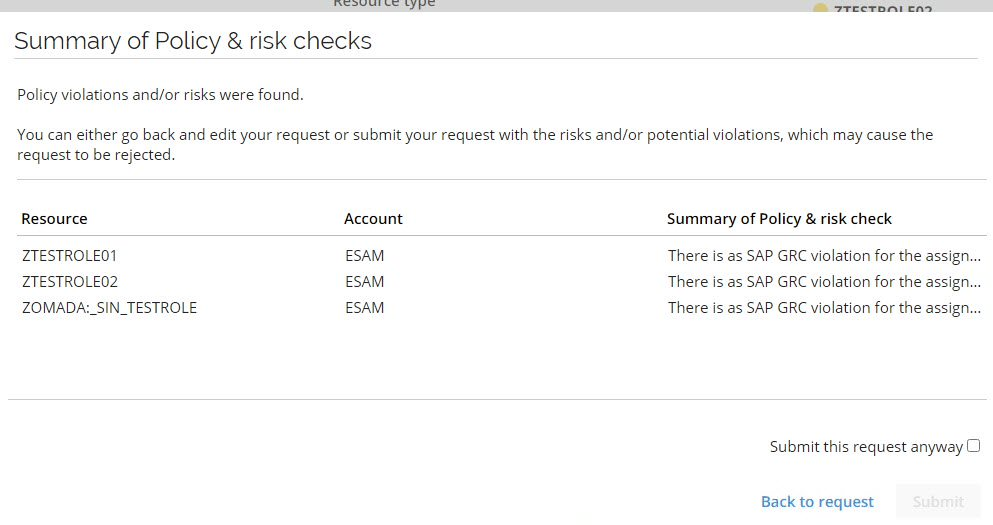
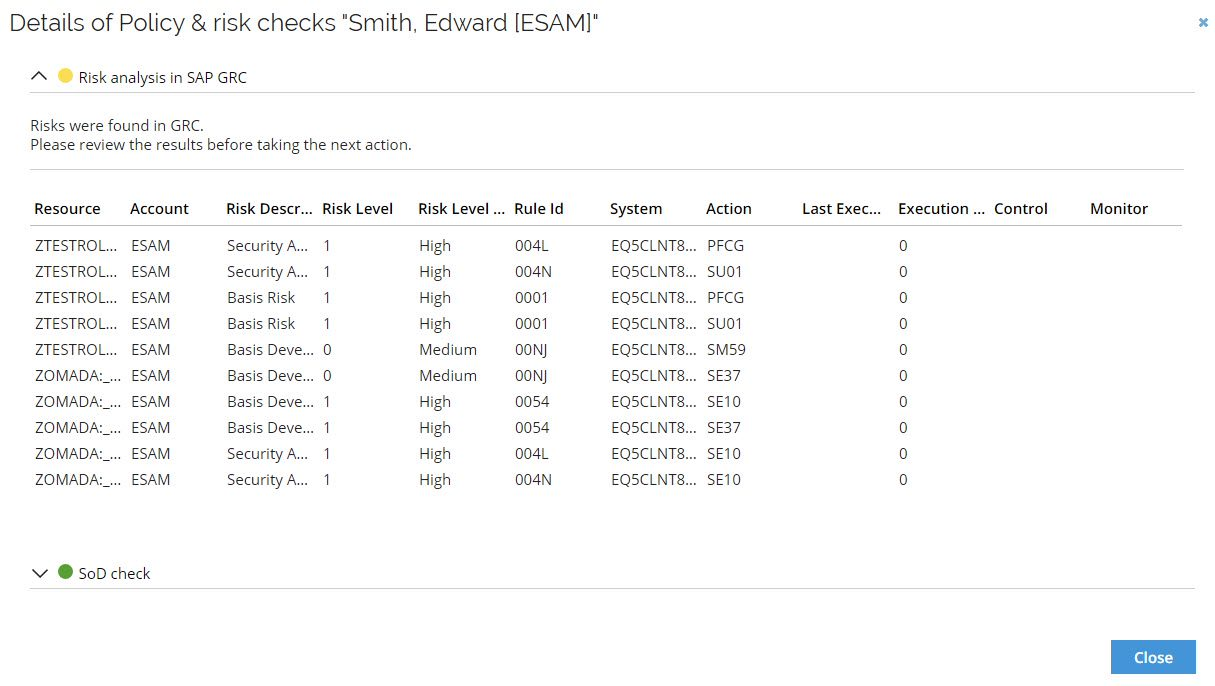
You can open the Details dialog for each identity to see additional details. All risks discovered in the Risk analysis are shown. Details about the resource, the identity, the risk level, as well as additional details related to the SAP GRC system are available.
The Role and Policy Engine (RoPE) component calculates assignments when all defined approvers (for example, managers and/or system owners) have accepted Access requests.
Unfolding request and approval resources to fit SAP roles
Omada Identity allows Access requests for any collection of resources, representing access at any level (for example, permission, application role, business role) and unfolding into a distinct list of resources at the permission level. Each SAP role will match one-to-one with a resource permission in Omada Identity, thus enabling greater mapping between Omada and SAP and facilitating the migration to SAP S4/HANA.
Enable GRC PRC
The configuration necessary for enabling the GRC PRC can be found in Setup > Policy & Risk checks > Risk analysis in SAP GRC. The configuration data object supports multiple WebRequestConfigurations objects, which allows multiple configurations to be used for multiple systems.
The properties of the configuration data object are as follows:
-
HitCount: The maximum number of hits (results) to return in the analysis.
- Optional/required: optional
- Default: 100
- PropertyType: int
-
ReportType: Determines the report types. [Optional] Default: [2, 3, 4]
- PropertyType: IEnumerable:int
- EnumValues:
- 01: Action Level
- 02: Permission Level
- 03: Critical Action
- 04: Critical Permission
- 05: Critical Role/Profile
- 06: Analytical Report
- 07: Mitigating Controls
- 08: Invalid Mitigating Controls
- 09: Alerts
- 10: Access Risk Assessment
- 21: SoD Reports
- 22: ERM Role
- 30: ROLE
- 31: USER
- 32: PROFILE
- 33: USERORG
- 34: ROLEORG
- 35: HROBJ
-
SystemPropertyName: System name of a property on the system data object type to use as the connector name in the risk analysis request.
- Optional/required: required
- PropertyType: string
-
ResourcePropertyName: System name of a property on the resource data object type to retrieve the resource identifier to be used in the risk analysis request.
- Optional/required: required
- PropertyType: string
-
OrgRule: The organizational rule to be applied in the analysis.
- Optional/required: optional
- Default: null
- PropertyType: string
-
RiskLevel: Filters the violations returned by the risk check based on their severity.
-
Optional/required: optional
-
Default: 0 (Medium)
-
PropertyType: int
-
EnumValues:
Value Risk Level 0 Medium 1 High 2 Low 3 Critical
-
-
RuleSetId: The ID of a ruleset defined in the target SAP GRC system. When provided, only violations belonging to the specified ruleset are returned. If omitted, the field is not included in the request and all rulesets are considered.
- Optional/required: optional
- PropertyType: string
-
WebRequestConfigurations: List of web request configurations to use in the risk analysis request.
- Optional/required: optional
- PropertyType: List: RiskAnalysisWebRequestConfiguration
If you are not using SoD checks in RoPE, disable the SOD Policy & Risk Check object in Enterprise Server (ES). If left enabled while unused, it triggers calls to ES during every RoPE calculation and may cause unnecessary latency and external requests.
The following properties are part of the RiskAnalysisWebRequestConfiguration object:
-
SystemUId: System UID of the system to use in the risk analysis request.
- Optional/required: required
- PropertyType: Guid
-
RiskAnalysisWithoutRequestWebReqConfig: Risk analysis web request configuration UID to use in the risk analysis request.
- Optional/required: required
- PropertyType: Guid
An example configuration data object (using defaults) is as follows:
{
  "HitCount": 100,
  "SystemPropertyName": "SYSTEMID",
  "ResourcePropertyName": "NAME",
  "RiskAnalysisWebServiceConfiguration": {
    "ReportType": [2, 3, 4],
    "RiskLevel": 1,
    "RuleSetId": "MYRULESETID"
  }
}
RiskLevel and RuleSetId are both optional. If neither is provided, the configuration behaves as before: all risk levels are included and no ruleset filter is applied.
Backwards compatibility
The new GRC PRC configuration is backwards compatible, meaning that the usual way of configuring the Web request config is still valid.
If you choose to use this method, you must exclude the field WebRequestConfigurations from the configuration data.
An example of a valid configuration data object is as follows:
{
  "ResourcePropertyName": "Resource",
  "SystemPropertyName": "System"
}
The configuration will use the default values for the missing fields.
Web request configuration
With this configuration you are connecting SAP GRC with a SOAP web request. The main purpose is to perform a risk an analysis with the grac_risk_analysis_wout_no_ws web service.
- Make sure that SAP web service is active and can be accessed.
- If authentication is required, configure the SOAP authentication type following the requirements.
- If your SAP instance requires HTTPS or any additional encryption, adjust the security protocol settings.
Configuration fields
-
URL: The URL points to the SAP web service endpoint for risk analysis.
http://[SAPSERVER]/sap/bc/srt/rfc/sap/grac_risk_analysis_wout_no_ws/100/grac_risk_analysis_wout_no_ws/grac_risk_analysis_wout_no_ws
Replace [SAPSERVER] with the actual SAP server hostname or IP. -
Action: This setting specifies the SOAP action for the request.
exampleurn:sap-com:document:sap:soap:functions:mc-style:GRAC_RISK_ANALYSIS_WOUT_NO_WS:GracIdmRiskWoutNoServicesRequest -
Request Type: For a SOAP-based integration, configure the setting to the SOAP value.
-
Content Type: Since SOAP messages follow XML format, configure the setting to the text/xml value.
-
Accept: Configure the setting to the text/xml value, for response to be also in XML format.
-
Timeout: Specifies how long Omada Identity waits for the response before a timeout occurs.
Ensure that in the EngineConfiguration.config RoPE configuration file, the SAPGRCPolicyCheckExtension part is not commented out.
...
<add type="Omada.RoPE.Controller.OISX.Extensions.SAPGRC.SAPGRCPolicyCheckExtension, Omada.RoPE.Controller.OISX"/>
  </extensions>
...
Composite role analysis
Follow the procedure to enable correct risk analysis of composite roles in SAP.
-
In the Resource data object type add the
SAPCompositeChildResourcesreference property. -
Go to the export mappings and change them so nested single roles in SAP system are stored as reference value in the
SAPCompositeChildResourcesreference property.- Go to Setup > All systems > Omada Identity and open Export mappings.
- Select New and afterwards Resources.
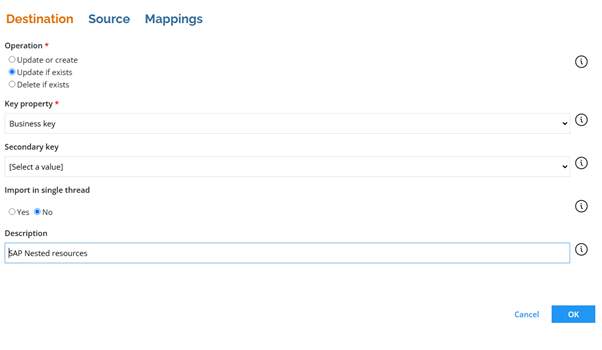
- Configure the settings in the Destination tab as shown below.
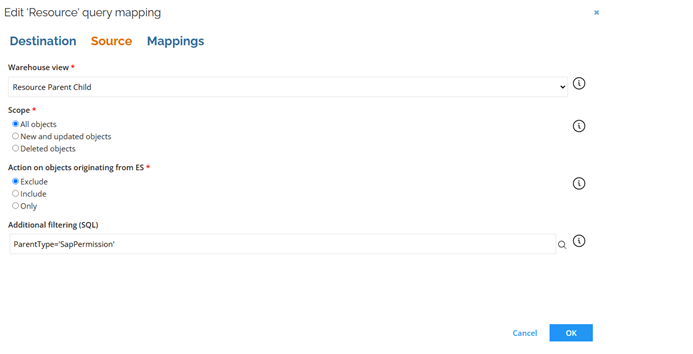
- Configure the settings in the Source tab as shown below.
- In the Mappings tab add the following mappings:
Destination Operator Source Business key Map ParentComposedBusinessKey SAP nested resources Map ChildComposedBusinessKey -
Go to the ExportMappingsReportingViews configuration object and include the resource parent-child view.
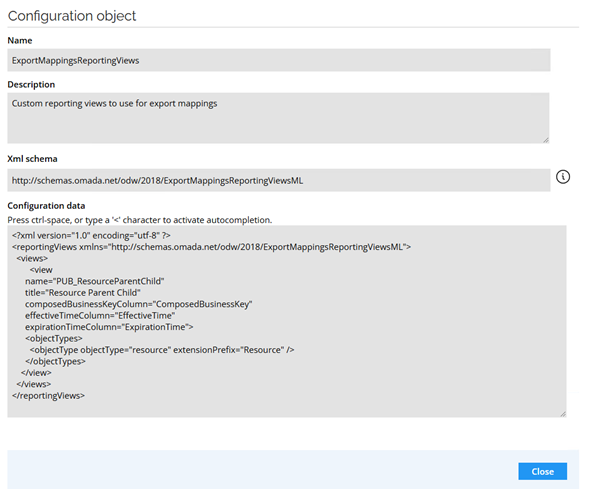 <viewname="PUB_ResourceParentChild"title="Resource Parent Child"composedBusinessKeyColumn="ComposedBusinessKey"effectiveTimeColumn="EffectiveTime"expirationTimeColumn="ExpirationTime"><objectTypes><objectType objectType="resource" extensionPrefix="Resource" /></objectTypes></view>